A garden of artificial life
Grow something surprising.
Cadence Garden grows artificial life in sealed jars: light comes in, heat goes out, and nothing else crosses the glass unless you open it. Plant one, feed it, wound it, breed it, and see what grows back. Nothing in there was told to be alive.
Needs a browser with WebGPU: current Chrome, Edge or Opera, Safari 26 (on a Mac, with macOS Tahoe), or current Firefox on Windows or an Apple silicon Mac with Tahoe. Without it the lab opens but cannot plant a world, and says why; the other pages on this site still read without it. No account, no install, no cookies. The journal is open to everyone.
What’s in a jar
Five ingredients. No recipe for life.
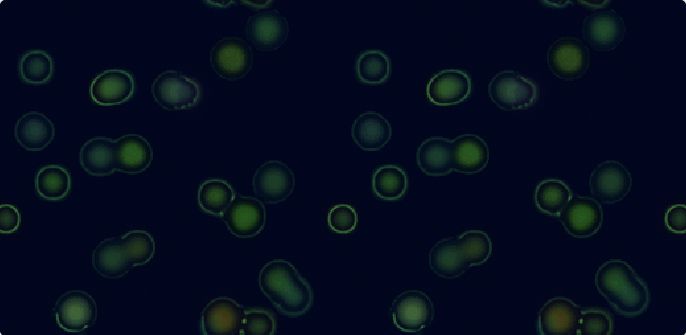
Every world is closed in matter and open to light. Inside, four kinds of matter turn into each other, and whatever lives has to make its living from that. The lab shows them in these same colours.
Light in, heat out.The only thing that crosses the glass, unless you open the jar. It can be steady, a gradient, a season, or a sun that wanders across the jar.
Dissolved food.What light turns into biomass. When it runs out, something has to recycle.
The living stuff.It grows, divides, moves, and carries a genome that mutates when it is copied.
Walls that bodies build.They decay, so staying in one piece takes constant work.
What’s left after work.Someone has to turn it back into food, or the whole jar stalls.
Nothing lost, nothing made.The rules conserve matter exactly. The lab checks the accounting as the world runs, logs every time you open the jar, and can replay a run bit for bit on another supported GPU.
Things that made us look twice
Three almosts worth chasing.
Leads from earlier sandboxes. Some were measured; some just looked alive enough to follow.
A reason to move
Hand-built sensing patterns survived a wandering sun where blind drifters failed. A changing world can make sensing matter.
Small sandbox comparisonMotion after a reset
Comet-like blobs appeared in ponds repeatedly cleared and restarted from small packets. Their movement caught our eye; it wasn’t measured.
Seen, not measuredBodies with more to them
Long, tangled bodies turned up in a few sandbox runs with inherited shape rules, and in the control worlds without them. Lovely to watch; not yet a difference.
Seen, in controls tooThe working hunch
Give life room to change.
Many steady worlds fill up, settle down and get boring. Some of the liveliest results came when space and resources opened up again: a wound, a pond reset, a moving patch of light.
So we’re turning up the possibilities. Combine changing environments, useful signals, varied founders and selection among groups. Look for the combinations that produce something worth watching.
The ambition: amplify a compelling trait tenfold. That’s a search target, not a result. Too much disturbance can erase the very bodies we want to grow.
Where this is going
From a strange little jar
to a garden we share.
Storm worlds and the breeder are in the lab as sandbox worlds. They are exploratory, not registered: no hypothesis about them was written down before the data. The naturalist and the shared garden are what we want to grow toward: the itch Spore never quite scratched.
- In the lab
Storm worlds
Moving light, seasons, wounds and inherited shapes in one world. Find a rhythm that keeps opening possibilities without wiping everything out.
- In the lab
The breeder
Choose which ponds seed the next generation by a trait we want to amplify. In the lab you can already pick the donor ponds by hand; the aim is a loop where people pick what fascinates them.
- An idea
An AI naturalist
A model that watches worlds, notices unfamiliar behaviour and helps steer the next experiment. A companion for exploring artificial life in the age of AI.
- Someday
The shared garden
A persistent archipelago. Creatures moving between islands. Visitors feeding a world, shifting its sun or dropping a meteor. Games and collaborative spaces that keep evolving while we’re away.
- Someday
More ways to be alive
Predation, richer body plans and new ways to interact. Change the rules where today’s worlds hit a ceiling, and see what becomes possible.
Come and dig in
Start with a world. Follow what’s interesting.
Plant a world, leave it running, and come back to see what changed. Share a seed that surprised you, or lend your GPU to queued experiments. The shared garden is the horizon; the lab is already open.